Protecting Your Rights,
Your Freedom & Your Future
Your Freedom & Your Future
Alabama Criminal Defense Lawyers









A drug charge attorney defends people charged with a drug crime. That can mean simple possession, trafficking, a drug conspiracy charge, or another drug offense. Your lawyer tests the state's proof, guards your rights, and builds a strong defense from the facts. Hiring a drug offense lawyer in Baldwin County early can change how your case ends.
Early representation matters. When an experienced Baldwin County defense attorney gets involved right away, the facts are still fresh and key evidence can be saved. Your lawyer can tell you to use your right to stay silent before police questions lead to harmful statements. Early help also lets your lawyer spot illegal searches and other rights problems at the arrest stage. For example, officers may lack probable cause for a search. Witnesses and surveillance footage may still be available. A drug case can also be charged in federal court instead of state court. Our federal crimes defense lawyers page explains how federal drug charges change your exposure.
Polson & Polson, P.C. is a criminal defense and drug crimes law firm serving Baldwin County. We handle all kinds of drug charges under Alabama's Uniform Controlled Substances Act. Alabama classifies controlled substances into Schedules I through V based on their potential for abuse and accepted medical use. The drug schedule and the nature of the conduct determine whether charges are filed as a misdemeanor or felony.
Alabama drug laws carry harsh penalties. The sentence depends on the class of the offense, the type and amount of the drug, and the person's criminal record.
Most drug charges in Alabama are felonies. Under Alabama law, unlawful possession of a controlled substance is a Class D felony. A Class D felony carries one year and one day to five years in prison.
Unlawful distribution is a Class B felony. It is punishable by two to twenty years.
Under Alabama law, marijuana possession for other than personal use is a Class C felony. The penalty is one year and one day to ten years.
Trafficking charges carry mandatory minimum prison terms. A judge cannot suspend or reduce these terms below the statutory minimum, unless the prosecutor moves for a reduction because the defendant gave substantial assistance.
For cocaine trafficking of 28 grams or more but less than 500 grams, the mandatory minimum is three calendar years. A $50,000 fine also applies.
Trafficking in methamphetamine at the same weight range carries the same mandatory minimums. At the highest weight thresholds, mandatory life sentences apply. Our drug trafficking defense attorneys look closely at how the state weighed and tested the substance.
Possessing a firearm during a trafficking offense adds a mandatory five year term and a $25,000 fine.
Under the Habitual Felony Offender Act, prior felony convictions increase the punishment classification. A defendant with two or more prior Class A or B felony convictions must be punished for a Class C felony if convicted of a new Class D felony. Multiple prior felonies can result in life imprisonment.
A drug conviction may also trigger driver's license suspension for trafficking or possession with intent to distribute. Other effects may include losing federal student aid, immigration problems, gun limits, and trouble getting a professional license. These effects vary from case to case.
Every drug case has weak spots. An experienced drug crime defense law firm checks every detail to find strong defenses. Drug felony lawyers build their plans around the approaches below.
The Fourth Amendment protects against unreasonable searches and seizures. Police must have a valid warrant, probable cause, or a recognized exception to search a vehicle, home, or person. Evidence seized without one of these may be suppressed. Without the drugs, the state often has no case.
The state must prove the defendant knowingly possessed the substance. When drugs turn up in a shared car, apartment, or common area, the state may struggle to prove guilt. The accused may not have known about the drugs or had control over them. Someone else may have left it there.
The prosecution must prove that the substance seized is actually a controlled substance. Defense lawyers test the chain of custody from the arrest scene to the crime lab. If evidence was stored wrong, labeled wrong, or handled by untrained staff, the results may not be reliable.
Statements made during custodial interrogation without proper Miranda warnings may be suppressed. If police questioned you in custody without reading you your rights, what you said could be kept out of court.
Sometimes police push a person into a drug crime they would not have committed on their own. An entrapment defense may apply in that case.
Many drug cases rely on tips from confidential informants. Defense lawyers question whether these informants can be trusted. They look closely when an informant got a deal in exchange for help.
Sometimes the seized substance is not what officers thought it was. Field tests can give false positives. A lab test is needed to confirm whether it is really an illegal drug.
A drug case attorney may also seek pretrial diversion or drug court instead of a trial. These diversion programs, covered below, may let eligible people avoid a felony conviction.
Baldwin County offers drug court and pretrial diversion options for eligible defendants. Under Alabama law, the district attorney may establish pretrial diversion programs that provide treatment-based alternatives to traditional prosecution.
Drug court programs mostly serve non-violent people with drug or alcohol problems. Each person gets a substance abuse evaluation. They follow a treatment plan and take regular drug tests. They also appear before the drug court judge. Finishing the program may lead to reduced or dropped charges.
Who qualifies varies and may change over time. An attorney drug defense plan should always ask whether diversion or drug court is an option. Confirm the current rules with your lawyer. The district attorney decides who gets in.
Knowing what happens after a drug arrest in Baldwin County helps you prepare for each stage.
Arrest and booking. After an arrest, the person is usually booked at the Baldwin County Corrections Center. Officers write up the charges. The person may be held until bond is set.
Initial appearance and bond. A judge sets bond and tells the person what the charges are. Bond conditions may include drug testing or travel restrictions.
Preliminary hearing. For felony charges, a preliminary hearing determines whether probable cause exists to hold the defendant for further proceedings.
Grand jury indictment. Felony drug cases in Baldwin County go before a grand jury. If the grand jury returns an indictment, the case proceeds to circuit court.
Arraignment. The defendant enters a plea at the Baldwin County Circuit Court in Bay Minette.
Pretrial motions. Defense lawyers file motions to suppress evidence, attack search warrants, or keep out statements police got the wrong way. Suppression hearings often decide where the case goes.
Plea negotiations or trial. Many drug cases end with a plea deal. When a fair deal is not possible, the case goes to trial before a judge or jury.
Drug charges in Baldwin County carry serious risks. These include jail time, mandatory prison terms, and lasting harm to your career, your license, and your future. The earlier you bring in a drug crime defense attorney, the more options may stay open.
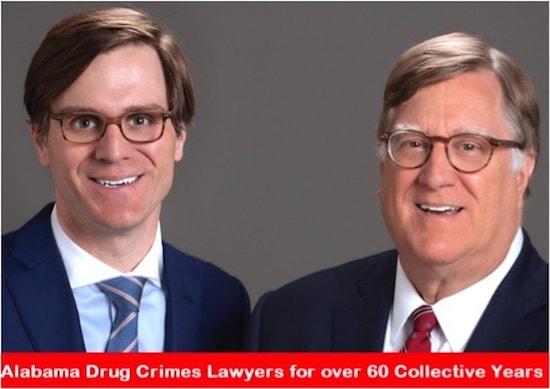
Polson & Polson, P.C. focuses on criminal defense in Baldwin County, including drug crime cases at every level. Our criminal drug attorneys also defend clients in other Alabama counties, such as Covington County. In a free first meeting, we review the facts of your arrest. We explain the criminal charges you face and talk through defense options. Everything you tell us stays private.
Do not answer police questions or make choices about your case without legal representation. Call Polson & Polson, P.C. at (205) 401-3171 or contact us online to schedule your consultation before your arraignment date.

Polson & Polson, P.C. offers payment plans so more people can afford a strong drug defense. We talk openly about fees at the first meeting. The cost depends on how complex the case is. As a drug crime law firm serving Baldwin County, we work with clients to find a payment plan they can manage. Money should not stand in the way of a strong defense.
Use your right to stay silent and ask for a lawyer right away. Do not agree to searches or answer questions about the case. Call a drug charge attorney without delay. Your lawyer can start reviewing the evidence and advise you on bond terms. Your lawyer can also spot defenses while the facts are fresh.
Under Alabama law, unlawful possession of a controlled substance in Schedules I through V is a Class D felony. Marijuana possession for personal use may be charged as a misdemeanor for a first offense. A second personal use conviction is a Class D felony. The classification depends on the substance, quantity, and the defendant's prior record.
No lawyer can promise a dismissal. A defense lawyer may find grounds to suppress evidence, such as an illegal search or a Miranda violation. Those grounds could lead to reduced or dropped charges. How strong your defenses are depends on the facts of your case.
Drug court eligibility depends on the offense, your criminal history, and your willingness to take part in treatment. The district attorney decides who gets in. A lawyer can review your situation and tell you whether drug court or pretrial diversion may be an option.


